
On May 10, in Ninh Binh, the Chemical Society of Vietnam organized a training seminar for enterprises on Corporate Social Responsibility (CSR) and Greenhouse Gas (GHG) inventory aimed at environmental protection.
The training session was attended by leading industry experts and representative chemical enterprises affiliated with the Chemical Society of Vietnam.
Enhancing Community Awareness and Emergency Incident Response
The chemical industry is a crucial economic sector manufacturing essential commodities for daily life and making substantial contributions to driving national economic growth. On the other hand, industrial incidents pose serious concerns regarding environmental integrity and public health. Consequently, the chemical industry must increasingly prioritize environmental protection, occupational health, and human safety, demonstrating higher corporate responsibility toward society.
Mr. Chu Van Nguyen - Vice Chairman of the Vietnam Chemical Enterprises Responsible Care Council, stated that corporate social responsibility is manifested through community contributions, environmental stewardship, fulfilling supplier responsibilities, ensuring consumer benefits, safeguarding labor rights and providing safe working conditions for workers, as well as preserving benefits for shareholders and company staff.
The ultimate objective of these endeavors is ensuring safety for people, the environment, and society, while delivering significant strategic value for enterprises.
Most enterprises under major chemical groups strive to minimize industrial pollution, prioritizing environmental protection in manufacturing operations by optimizing raw material and energy efficiency.
Furthermore, promoting voluntary social responsibility through mindset change and environmental management practices backed by technical solutions yields both economic returns and enhanced corporate reputation and brand equity.
Staff training and involving local communities in incident response drills constitute key priorities. Chemical facilities must conduct incident drill plans at least once a year to assess emergency readiness and bridge the gap between planning and execution, while sharing response know-how across regional industrial facilities and local communities.
Importance of Greenhouse Gas (GHG) Inventory Training
Greenhouse gas inventory involves collecting emission source data, quantifying GHG emissions and carbon removals within defined spatial boundaries over a specific reporting year in accordance with regulatory methodologies. Common greenhouse gases include carbon dioxide (CO2), methane (CH4), nitrous oxide (N2O), and fluorinated gases.

Ms. Tran Thi Thu Hang, representative of Mecie Carbon Credit Consulting & Inventory JSC,
guides the preparation of GHG inventory reports.
Waste handling represents one of five major greenhouse gas emission sectors in Vietnam, accounting for approximately 31.3 million metric tons of CO2 equivalent in 2020. By 2030, waste emissions are projected to rise to roughly 40 million tons CO2e under business-as-usual scenarios if unaddressed. Effective municipal and industrial waste treatment directly mitigates greenhouse gas emissions, advancing national climate targets.
According to the Ministry of Natural Resources and Environment, the country houses 1,322 domestic waste treatment facilities, including 381 solid waste incinerators, 37 compost/fertilizer production lines, and 904 landfills. Major emissions stem from landfills (50.3%) and wastewater treatment (43.2%).
Vietnam aims to reduce waste sector greenhouse gas emissions to 29.4 MtCO2e (a 63% reduction) compared to BAU by 2030 with international climate support. At the national level, Vietnam has tracked GHG emissions for 20 years with robust performance relative to developing economies; however, implementation at the enterprise level remains relatively nascent.
Aside from pioneering corporations, most manufacturers encounter hurdles: lack of detailed sectoral GHG guidelines for specific manufacturing fields, shortage of qualified in-house carbon accounting personnel to manage monitoring systems, and supply chain data complexities influencing accounting precision.
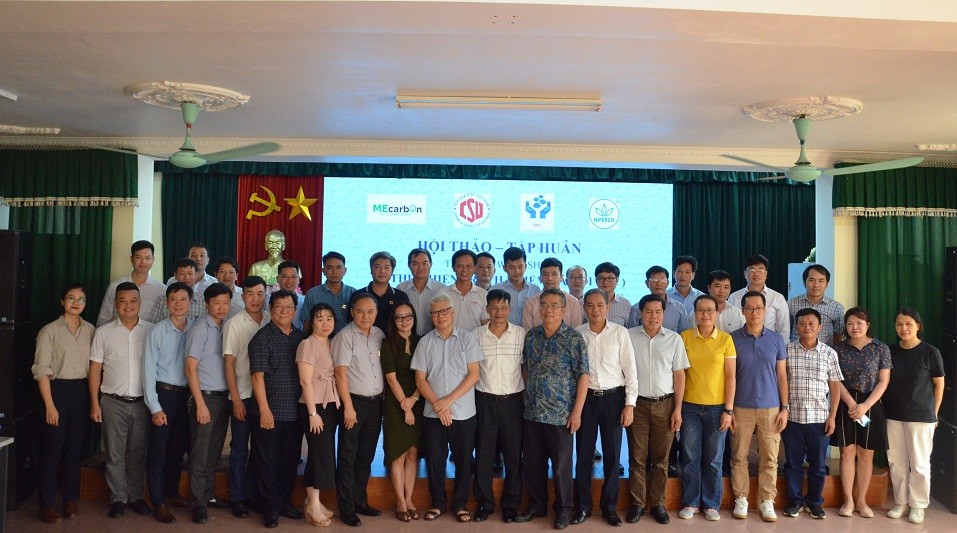
Experts and enterprise representatives from the Chemical Society of Vietnam at the training conference
Despite initial hurdles, conducting GHG inventories yields massive strategic dividends. Enterprises must promptly build greenhouse gas inventory roadmaps to satisfy compliance standards and enhance competitive standing in export markets.
At the conference, chemical manufacturers were briefed on carbon markets and carbon credit trading mechanisms. Emission reductions achieved across chemical facilities represent verifiable carbon offsets tradeable on compliance and voluntary carbon markets.
Chemical enterprises play a decisive role in national climate pledges. Facilities must pursue green transitions, adopting low-carbon industrial equipment and renewable power to phase out fossil energy such as coal, oil, and gas.
Because chemical plants operate continuous fixed process regimes, long-term technological roadmaps are essential. GHG inventory serves as the foundational baseline to locate an enterprise on the national emission map and design cost-effective decarbonization pathways.
On this basis, regulatory bodies can allocate fair emission allowances, while enterprises gain access to international green finance mechanisms and sustainable capital.
Complying with GHG inventory regulations represents a tangible commitment alongside the Government to fulfill international climate pledges. It also prepares plants for carbon border taxes, green labeling, and sustainable resource management.
Source: Industry and Trade Magazine (Bao Cong Thuong)