Contributing comments on the draft Law on Chemicals (amended), numerous delegates addressed investment incentives and promotional mechanisms for the chemical industry.
Investment Incentives Needed to Propel Chemical Industry Development
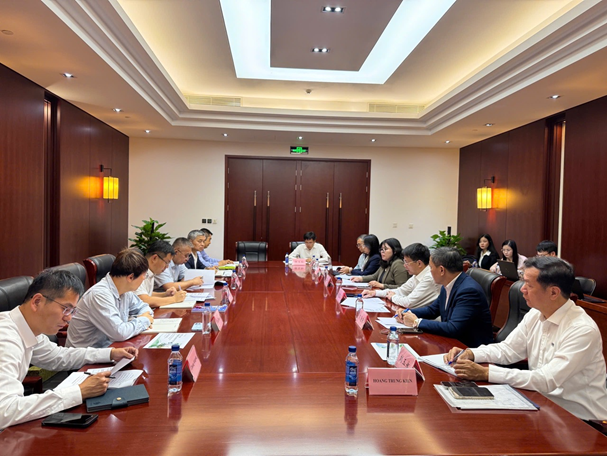
On the morning of February 7, 2025, continuing its 42nd session, the National Assembly Standing Committee provided feedback on the explanation, absorption, and revision of the draft Law on Chemicals (amended).

| Vice Chairman of the National Assembly Nguyen Duc Hai presides over the session |
At the session, members of the National Assembly Standing Committee fundamentally concurred with the orientations regarding major issues of the draft Law on Chemicals (amended), including the law's title; provisions on chemical industry development strategies; responsibilities in formulating and executing strategies for the chemical industry; incentives for core chemical sectors; chemical usage; registration and management of new chemicals and hazardous chemicals in consumer goods; and formulation of chemical accident prevention and response plans at the enterprise and provincial levels.
Chairman of the Legal Committee Hoang Thanh Tung agreed with many contents absorbed and finalized by relevant drafting agencies, noting that key recommendations from the Legal Committee had been incorporated.
Regarding investment incentives, Mr. Hoang Thanh Tung pointed out that Clause 1, Article 7 of the draft law currently stipulates that chemical investment projects satisfying specified criteria shall be entitled to special investment incentives and support in accordance with the Law on Investment and relevant legislation.
"In principle, we concur and propose that the lead verifying agency and drafting agency continue reviewing against Party guidelines and resolutions to explicitly define the scope, specific projects, and eligible project categories entitled to special investment support" - Mr. Tung stated.
According to the Chairman of the Legal Committee, provisions under Article 7 require comprehensive assessment to determine whether amendments to the Law on Investment are necessary. Currently, Clause 2, Article 20 of the amended Law on Investment does not encompass chemical projects specified in this draft law. Consequently, Article 7 would lack enforceability unless harmonized with the Law on Corporate Income Tax scheduled for approval alongside the amended Law on Chemicals.

Chairman of the Legal Committee Hoang Thanh Tung
The current Corporate Income Tax Law only references Clause 2, Article 20 of the Law on Investment for special corporate income tax incentives.
Enacting special investment support in this Law without corresponding tax incentives in the Corporate Income Tax Law would render provisions ineffective. "We recommend seamless synchronization between Government agencies and National Assembly committees when refining corporate income tax legislation" - Mr. Tung noted.
Mr. Tung also mentioned that during the 8th Session, the National Assembly Standing Committee dispatched an official request directing the Government to review and safeguard inter-legislative consistency across concurrent draft laws submitted to the legislature.
When submitted at the 8th Session, the draft Corporate Income Tax Law significantly narrowed preferential tax scopes—reducing eligible sector categories from approximately 100 down to around 30.
Eliminating numerous preferential categories while expanding incentives in the Law on Chemicals would create contradictory legislative trajectories, compromising legal coherence and neutralizing statutory efficacy.
Chairman of the Finance and Budget Committee Le Quang Manh also shared insights on investment incentives for the chemical industry, emphasizing its strategic role in national industrialization and modernization.
According to Mr. Le Quang Manh, designing incentives via cross-referencing to the Law on Investment aligns with sound legislative principles. However, the Law on Investment encompasses broader incentives beyond taxation. Presently, incentive implementation faces practical hurdles due to inter-law disharmony.
Addressing tax incentives to be presented in the 9th Session, Mr. Manh conveyed that in discussions with the Ministry of Finance, the Government maintained its stance of narrowing tax preference scopes.
The Chairman of the Finance and Budget Committee recommended that in drafting Article 7, beyond cross-referencing the Law on Investment, clear guiding principles should outline supportive measures and investment funds to nurture chemical industry growth. "For instance, utilizing investment support funds serves as an effective mechanism assisting local authorities in environmental remediation when hosting key chemical investment projects" - Mr. Manh suggested.
Ensuring High Quality of Draft Law Submitted to the National Assembly
Concluding the session, Vice Chairman of the National Assembly Nguyen Duc Hai requested the Committee on Science, Technology and Environment to collaborate with relevant agencies in synthesizing feedback to ensure thorough, persuasive explanations; thoroughly institutionalizing Party policies and ensuring high-quality legislative drafts.
Furthermore, reviewing agencies must ensure systemic consistency and feasibility across the legal framework, notably in relations with the Law on Investment, Corporate Income Tax Law, Advertising Law, Environmental Protection Law, and Civil Defense Law; upholding strict adherence to Resolution 27 and Regulation 178.

Chairman of the Finance and Budget Committee Le Quang Manh
Regarding contentious matters, agencies should consider assigning administrative regulations to the Government to maintain flexibility, avoiding over-legislating administrative decrees and circulars.
Vice Chairman Nguyen Duc Hai also noted the need to thoroughly institutionalize Conclusion 36 of the Politburo on phasing out hazardous chemicals causing water pollution, and Conclusion 81 regarding green transition, innovation, circular economy, and just energy transition.
Additionally, fast-track licensing mechanisms for new chemicals in emergency situations should be reviewed to balance safety oversight with urgent public requirements.
"The overarching principle is minimizing administrative procedures and compliance costs for citizens and enterprises, while maintaining targeted oversight in this specialized field" - the Vice Chairman affirmed.
Moreover, planning provisions must align with the Law on Planning to avert procedural bottlenecks in chemical industrial planning.
The Committee on Science, Technology and Environment will take the lead, coordinating with the Ministry of Science and Technology and relevant bodies, to incorporate opinions from the Standing Committee and complete the dossier for National Assembly submission.
| At the session, the National Assembly Standing Committee commended the proactive efforts of the Committee on Science, Technology and Environment, the Ministry of Industry and Trade, and related ministries in synthesizing delegates' opinions to revise and finalize the draft Law. |
Source: Industry and Trade Magazine (Cong Thuong)