| Chemical Industry Engineering Joint Stock Company: Prioritizing Science and Technology, Enhancing Competitiveness |
Aligning Economic Growth with Environmental Protection
Vietnam has achieved remarkable progress in sustainable development. However, the country faces rapidly rising industrial waste volumes alongside depleting virgin raw material and fossil resources. Furthermore, obsolete technologies, fragmented production scales, and limited capital for recycling technologies remain bottlenecks. Notably, unsynchronized equipment and operational instability across several industrial segments require prompt resolution. Consequently, identifying environmental challenges and formulating effective technological solutions in the coming period is paramount to harmonizing socio-economic expansion with ecological protection and sustainable development.
| CECO continues researching phosphogypsum valorization to generate high-value derivative products, delivering economic efficiency for DAP fertilizer plants |
Implementing the directives of the Party and State on economic growth and environmental stewardship, the Industry and Trade sector—encompassing heavy industries such as coal, mining, and chemicals—consistently couples production with environmental responsibilities. Priorities center on greening manufacturing processes, promoting sustainable consumption, and boosting waste recycling, reuse, and energy recovery. Concurrently, the sector actively addresses environmental challenges guided by Government strategies: the National Green Growth Strategy, the Renewable Energy Development Strategy, and the National Strategy for Integrated Solid Waste Management.
As a premier engineering consulting enterprise with over 50 years of expertise, Chemical Industry Engineering Joint Stock Company (CECO) possesses deep insight into the intricacies spanning project preparation to commercial plant commissioning. CECO has accompanied the Department of Chemicals (Ministry of Industry and Trade) in master planning for the chemical sector, formulating the development strategy for Vietnam National Chemical Group (Vinachem), and providing comprehensive policy feedback on the revision of the Construction Law and the Chemical Law. These contributions help build a transparent, effective, and feasible legal framework while instituting robust enforcement mechanisms for environmental sustainability in the chemical sector.
Gypsum - A Vital Secondary Resource
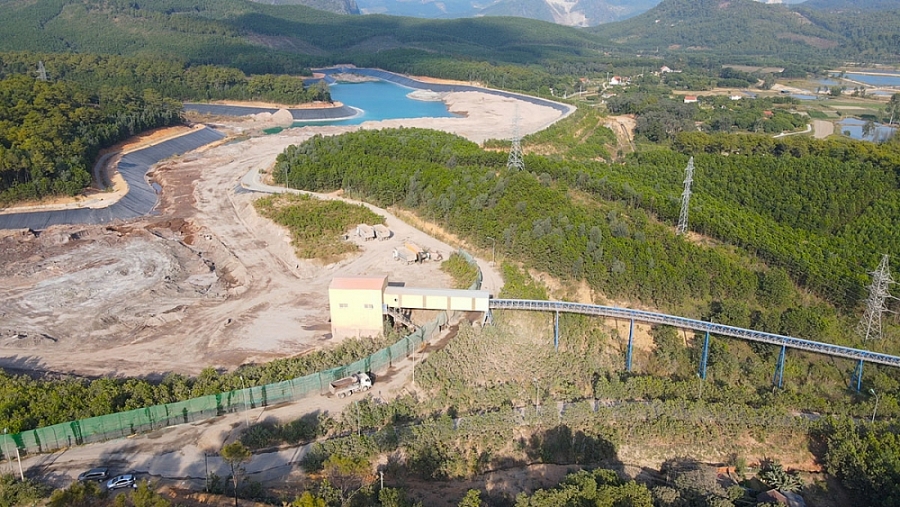
Presently, a primary challenge confronting the Industry and Trade sector is escalating industrial waste generation against diminishing raw materials. Annually, industrial residues such as thermal coal fly ash, slag, and phosphogypsum (PG) from DAP fertilizer plants reach up to 16 million tons. These volumes remain underutilized as inputs for other manufacturing sectors, compelling Vietnam to spend substantial foreign exchange importing raw materials for industry and agriculture.
Thus, alongside challenges, huge opportunities exist in recycling, raw material recovery, and energy generation from industrial wastes, especially phosphogypsum. Effectively utilizing PG stockpiles as secondary feedstocks represents an urgent imperative for DAP fertilizer plants, not only resolving environmental footprint and storage burdens but also proactively securing secondary raw materials for downstream sectors.
| CECO proactively develops scientific and technological research programs ensuring environmental safety at fertilizer and chemical plants, contributing to a clean and green industrial ecosystem |
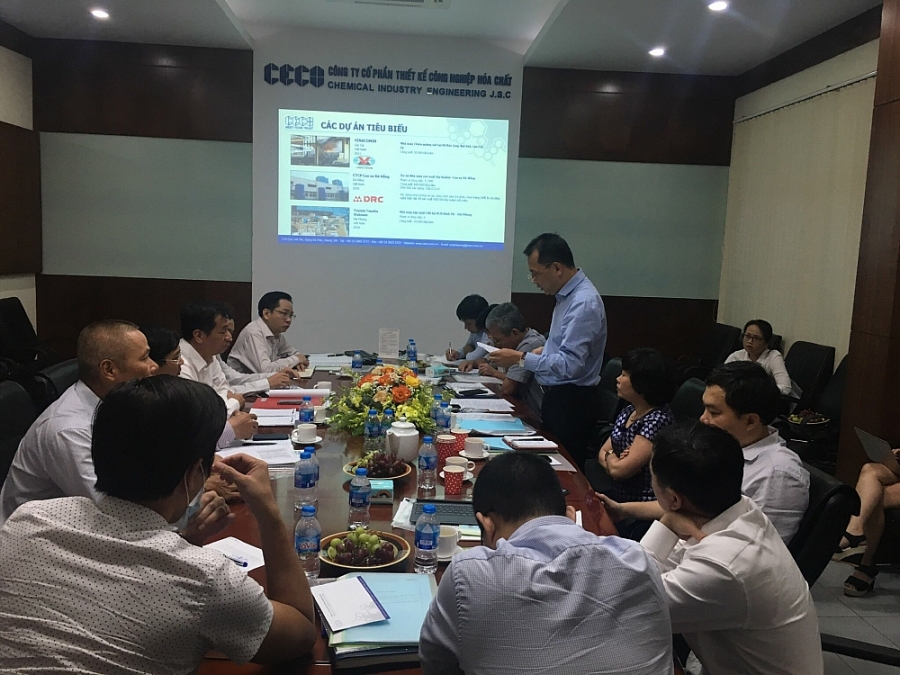
Serving as project development consultant and EPC contractor, CECO participates across all phases—from initial feasibility studies to operational process revamping for fertilizer and chemical plants. Recognizing phosphogypsum as an unexploited resource that can be transformed into high-value products, CECO has relentlessly spearheaded research initiatives to overcome this technological bottleneck.
Following thorough pilot research at the company's experimental testing facility in Xuan Phuong, results demonstrated high feasibility in utilizing phosphogypsum waste to manufacture Ammonium Sulfate (AS / (NH₄)₂SO₄)—a vital fertilizer extensively used in Vietnamese agriculture.
Currently, due to the lack of domestic production, Vietnam imports 100% of its Ammonium Sulfate demand, averaging 1.2 to 1.5 million tons annually for direct application and compound NPK fertilizer production. Global AS market price volatility heavily impacts domestic agricultural costs. Producing AS domestically will significantly curtail dependence on imports and stabilize national fertilizer markets.
Nevertheless, for any emerging scientific initiative, rigorous economic evaluation upon industrial scaling remains paramount. Studies indicate that producing AS alone primarily addresses environmental remediation without optimizing commercial returns. Synthesizing international and domestic research breakthroughs, CECO is expanding R&D into comprehensive product chains from gypsum to generate high-value derivatives, unlocking economic sustainability for DAP plants and specialized waste treatment investors.
Success along this technological trajectory will simultaneously solve ecological and commercial equations to "green" DAP fertilizer facilities: completely eliminating phosphogypsum stockpiles, yielding innovative product lines, reducing production costs, outcompeting substandard fertilizers, and restoring ecological landscapes for industrial cities like Hai Phong and Lao Cai. Realizing this vision calls for strategic investment from the Ministry of Industry and Trade alongside private capital partnerships.
In the near future, Vietnam can achieve efficient, sustainable resource stewardship, safeguarding ecological, environmental, water, food, and energy security.
| Since 2010, CECO has executed over 70 scientific and technological research tasks at all levels, covering manufacturing technologies, equipment localization, industrial waste treatment, environmental protection, hazardous waste management, and design data standardization. The majority of these research results have been successfully transferred and applied by research institutions and enterprises, fulfilling strategic corporate development objectives while effectively optimizing engineering design and construction-installation across CECO's industrial projects.
Source: Industry and Trade Newspaper (Báo Công Thương) |